My talks for the Victoria Arts Council, one at theDock and the other for Creative Mornings, I now consider as bookends. One beginning a call and the other confirming that call.
I had come to a crossroads with my Christian community, both for personal and artistic reasons, and these were overlaid with historical and humanitarian reasons. Many at the time were questioning their commitment to an institution which had done so much harm to Indigenous peoples. The evidence of unmarked graves in the grounds of residential schools raised grief, disgust and doubts about church with revelations of its role in genocide that could no longer be buried out of sight of conscience.
And yet, in my life as a survivor of trauma, Christian community has been a source of stability and growth. Trust in the person of Jesus and his teachings have sustained my sense of humanity and worth, and scaffolded my recovery from childhood trauma and grief. Relationships and friendships in Christian community are still precious to me. Nevertheless, I wondered if I could even be part of church anymore.
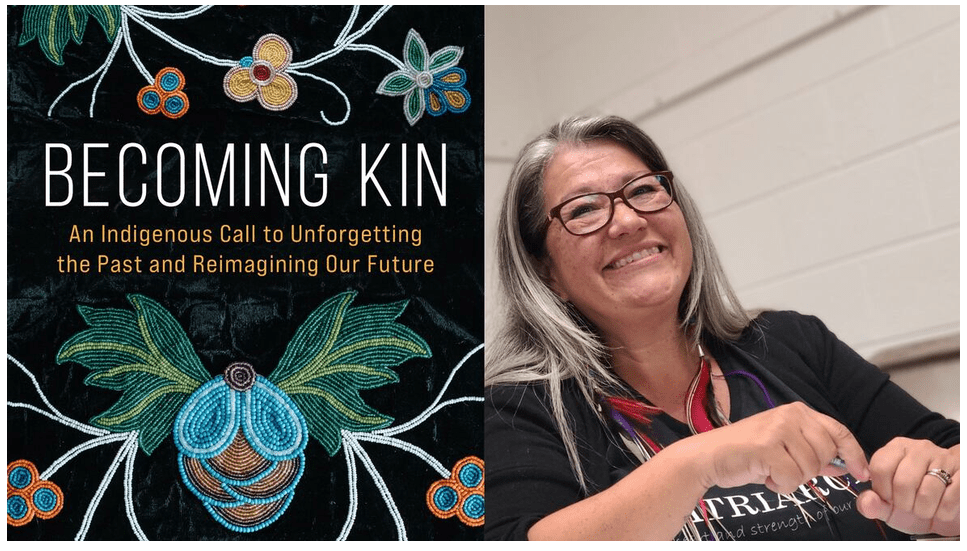
While I was preparing my talk at theDock and wrestling with this question, I happened upon an interview with Patty Krawec an Anishinaabe writer from Lac Seul First Nation on CBC Radio. The book that was being talked about was ‘Becoming Kin, Unforgetting Our Past and Reimagining Our Future’. This interview spoke into my dilemma. Krawec asked what was in Christian theology that allowed “good” Christians to stay silent. (I interpreted it as: what was in Christian theology that enabled the horror of the residential school system?)
By the time I gave my Creative Mornings talk, a year or so later, I had come to the realisation that it was not what was in the theology, but what was not in the theology. And what was not in the theology were women’s voices, 2SLGBTQIA voices, Indigenous voices, Black voices, Brown voices, disabled voices, working-class voices, poor voices. All sorts of voices were missing. And since the Reformation, so were artists’ voices.
In the interview, Krawec goes on to say:
“I think there’s hope in the (Scriptural) text, I think there’s possibility, I don’t think it has to be read the way that it’s often being read because I hear other people reading it differently but that’s not the dominant message and that’s not the message that is shaping our world.”
In Krawec’s interview I hear a call to be part of the work of decolonisation and reconciliation by approaching my spiritual tradition differently. To recognise that there is more than one lens through which to read sacred scripture and develop theology.
My particular lens is faceted as an artist, a disabled person, a third culture person, a recovering traumatised person, a working-class person, and a woman. Many voices like mine belong to people who can open up sacred text and religious life beyond the parameters of patriarchal, colonial presumptions.
I realised that I want to be part of the work of reimagining my faith tradition as an artist through theopoetic practice. It is my belief that we must include the creative, artistic voice in our decolonisation, reconciliation and social advocacy work.
With that realisation, I had found a reply to my dilemma.
It’s been almost four years since my talk at theDock and my hearing of the Patty Krawec interview. In that time, I have taken on a role as Artist Advocate at St John the Divine. St John’s is a progressive, 2SLGBTQIA+ affirming community committed to social justice and the ongoing work of Truth and Reconciliation. In my role, I have found a place to integrate my art practice and my spirituality within the context of community that is seeking to face the past and imagine a different future.
Here is an edited excerpt from the Tapestry interview, which spoke to me so deeply.
Patty Krawec excerpt, Tapestry interview, November 13, 2022 (at 24:10)
MH: You grew up going to Christian churches… and I think you are part of a Christian congregation…. Is Christianity still a good fit for you?
PK: Well, if we were on FB I would say “it’s complicated” (small laugh), just because of those threads I had followed back – so many lead to the church and lead to theology – and it’s so easy and simple for Christians to say, “Oh well, those were bad Christians who did that,” or “they weren’t real Christians who did that,” or “if they were real Christians they would have behaved differently,” or “my church didn’t run a residential school.”
And I say, OK, fine, but what was it in your theology that kept you quiet? Because you stayed quiet, your church stayed quiet. (I had remembered this as “what was in your theology that made residential schools possible?” or something like that.) Your church didn’t do anything about this.
So I desperately need to hear – and I do, from some friends I do hear that willingness to engage and analyse and consider, but it’s rare, and I’m increasingly unable to tolerate it…. When I hear that kind of refusal to engage, to consider and to analyse, this persistent idea that the church is the source of all goodness in the face of all the things the church has been part of.
I think there’s hope in the text, I think there’s possibility, I don’t think it has to be read the way that it’s often being read because I hear other people reading it differently, but that’s not the dominant message and that’s not the message that is shaping our world.
MH: …I’m wondering if you’ve been tempted just to say, “I’m closing that door… too much harm has been done and too much damage has been done, not enough has been acknowledged – I’m walking away.”
PK: …The last time I got close to that edge it was a Jewish Rabbi who pulled me back…. It was a conversation with Rabbi Danya Ruttenberg … on Twitter, privately … and she reminded me of the possibility and the good work that’s been done and reminded me to … shift my gaze that way and to acknowledge and recognise the harms but to not let go of the possibility that remained.
And I do speak the language, I understand the views… and so maybe my work in terms of speaking to Christians about how they could do better, how they could read their text differently, maybe that’s not over yet, so I dunno…. There may come a time, but I guess we’re not there yet.
Patty Krawec is an Anishinaabe and Ukrainian writer from Lac Seul First Nation. She is the cohost of the Medicine for the Resistance podcast and cofounder of the Nii’kinaaganaa Foundation, which collects funds and disperses them to Indigenous people and organizations. Her work has been published in Sojourners and Canadian Living. She is active with the Fort Erie Native Friendship Center and the Strong Water Singers. Krawec is a member of Chippawa Presbyterian Church and lives in Niagara Falls, Ontario.

